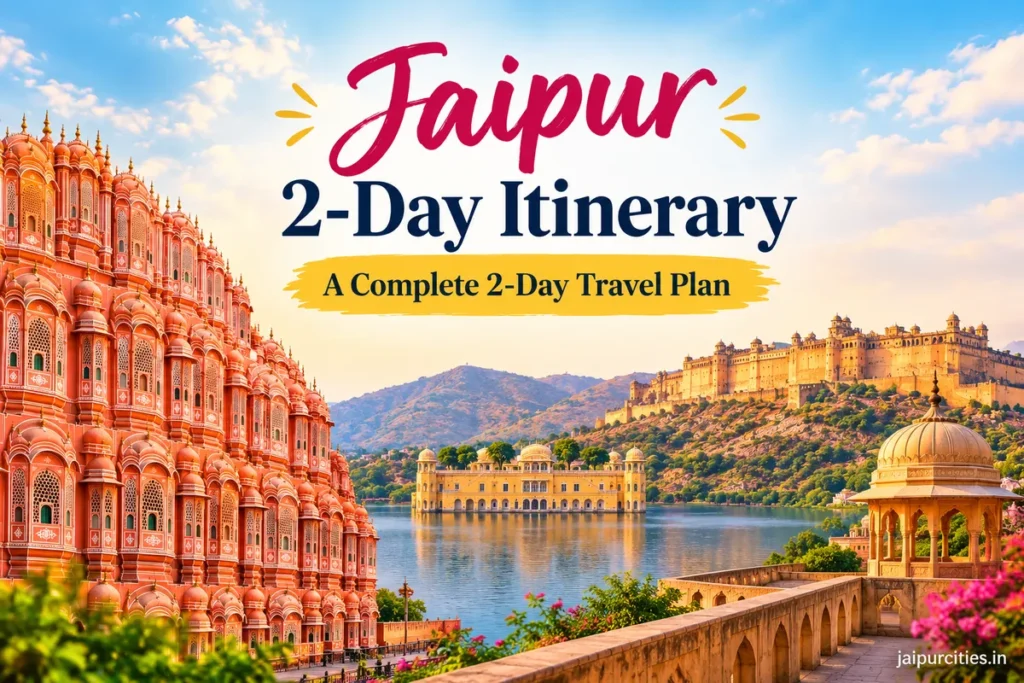
Two days is the sweet spot for the Pink City. It is long enough to see the major forts and palaces without sprinting, and short enough to fit into a weekend. If you have been searching for a 2 day itinerary for Jaipur that balances sightseeing, food and downtime, this guide is built for you.
The plan below splits Jaipur into two natural halves. Day one belongs to the old city, with its royal palace, observatory, museum and bazaars. Day two belongs to the hills and the forts, finishing with a sunset that most travellers remember long after they go home. Every stop links to our detailed attraction pages, and the whole plan is part of our larger Jaipur Itinerary guide.
Jaipur 2 Day Itinerary at a Glance
Day 1: Hawa Mahal, City Palace, Jantar Mantar, Albert Hall Museum and the old city bazaars. Day 2: Amber Fort, Jal Mahal, Jaigarh Fort and sunset at Nahargarh Fort.
Best time to visit: October to March. Ideal for: Couples, families, friends, first-time visitors and weekend travellers. Where to base yourself: C-Scheme, MI Road or the Old City keeps travel times short.
Day 1: The Royal Old City
Day one is about the walled city, where history, markets and daily life all share the same streets. Most of today’s sights are close together, so you will spend less time in the car and more time exploring.
Morning: Hawa Mahal (9:00 am)
Begin at Hawa Mahal. In the early morning, the sandstone façade glows pink-orange, and the street in front is still relatively calm. Built in 1799 by Maharaja Sawai Pratap Singh, this five-storey structure has 953 small windows that were designed to let royal women watch festivals and processions without being seen. The honeycomb pattern also helps air circulate, which is how the palace earned its name.
Take your photographs from one of the cafés across the road, then go inside to climb the ramps and look out through the jharokhas. Allow about 45 minutes.
Late Morning: City Palace (10:00 am)
From Hawa Mahal, it is a short walk or ride to City Palace. Constructed between 1729 and 1732 by Maharaja Sawai Jai Singh II, this sprawling complex still serves as the residence of the former royal family, with sections open as a museum.
Walk through the Mubarak Mahal, which displays royal textiles and costumes, and the armoury with its ornate weapons. Pritam Niwas Chowk is the highlight for photographers, with four beautiful gateways that represent the seasons. Don’t forget to look at the two enormous silver vessels, among the largest silver objects in the world, and the seven-storey Chandra Mahal, parts of which can be visited on special tours.
Plan around two hours here. If you enjoy detail, an audio guide or local guide is well worth it.
Midday: Jantar Mantar (12:30 pm)
Right next to City Palace is Jantar Mantar, a UNESCO World Heritage Site and the largest of the observatories built by Jai Singh II. Completed in 1734, it contains 19 astronomical instruments, including the Samrat Yantra, a sundial about 27 metres high.
It can look confusing at first, but with a guide, each instrument becomes fascinating, whether it is measuring the position of the sun, tracking constellations or calculating the time. Allow 45 minutes to an hour. Bring a hat, as there is little shade.
Lunch (1:30 pm)
Take a proper break for lunch. The streets around the old city and MI Road are full of eateries, from simple kachori stalls to sit-down thali restaurants. Try dal baati churma, gatte ki sabzi, ker sangri or a plate of pyaaz kachori with chutney. Finish with a lassi.
Afternoon: Albert Hall Museum (3:00 pm)
Spend the afternoon at Albert Hall Museum, also known as the Central Museum. Designed in Indo-Saracenic style by Samuel Swinton Jacob and opened in 1887, it is as impressive for its building as for its collection. Inside you will find miniature paintings, carpets, metalwork, pottery, ivory carvings and, famously, an Egyptian mummy.
The building is at its most beautiful after dusk, when it is lit up, so if the museum closes early, come back later to see it from outside. Spend around 90 minutes inside.
Evening: Bazaars and Dinner (5:00 pm)
The old city’s markets are at their liveliest in the evening. Walk through Johari Bazaar for jewellery and gemstones, Bapu Bazaar for textiles, bags and juttis, and Tripolia Bazaar for lac bangles and brassware. Watch for the iconic block-printed fabrics and blue pottery, which make good souvenirs.
For dinner, pick a restaurant that serves Rajasthani thali or try one of the rooftop spots with a view of the illuminated Hawa Mahal. Rest well, because tomorrow starts early.
Day 2: Forts, Lakes and Sunset
Day two takes you out of the city and up into the Aravalli hills. This is the most visually dramatic part of the trip, and also the day that needs the earliest start.
Early Morning: Amber Fort (8:00 am)
Arrive at Amber Fort when it opens. The mornings are cooler and calmer, and the soft light brings out the red sandstone and white marble. Raja Man Singh I began building the fort in 1592, and later rulers added to it, which is why it blends Rajput and Mughal design so naturally.
Enter through Suraj Pol, climb to the main courtyard and explore the Ganesh Pol, the Diwan-i-Aam and the Sukh Niwas. The Sheesh Mahal, covered in tiny mirrors, is the highlight. Take your time on the upper terraces, from where you can see Maota Lake and the long defensive walls running over the hills.
You can walk up to the fort or take a jeep from the base. Spend around two and a half hours here. If you have time, stop by Panna Meena ka Kund on the way down.
Late Morning: Jal Mahal (11:00 am)
On the road back to the city, stop at Jal Mahal for a photo break. The palace seems to rise straight out of Man Sagar Lake. Only the top floor is visible when the water is high, which adds to the mystery. You cannot go inside, but a walk along the promenade and a cup of chai makes for a pleasant half hour.
Lunch (11:45 am)
Have lunch at a restaurant near the lake or head back toward the city. If you want something light, many cafés in the area serve sandwiches, thalis and fresh juices.
Afternoon: Jaigarh Fort (1:30 pm)
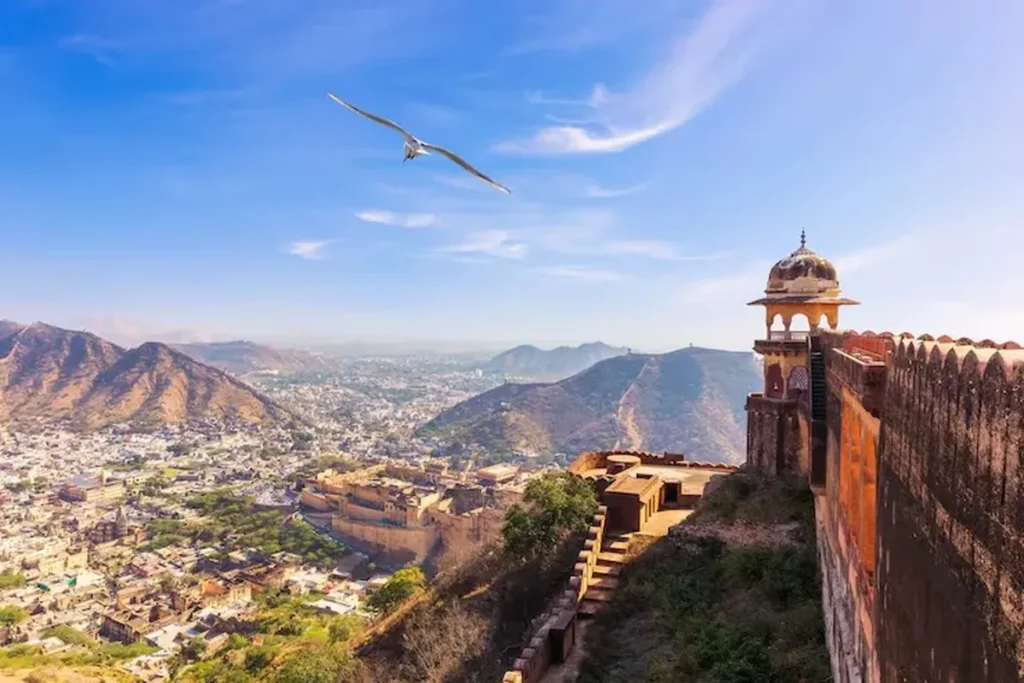
Next, head up to Jaigarh Fort, the “Fort of Victory”, which sits on the ridge above Amber and was built by Sawai Jai Singh II around 1726 to protect it. A long passage once connected the two forts.
Its real draws are the powerful ramparts, the armoury and the Jaivana Cannon, which was one of the largest cannons on wheels in the world when it was made. The views from the watchtowers over Amber, the lake and the valley are spectacular. Spend around 90 minutes, and keep plenty of water with you.
Late Afternoon: Nahargarh Fort (4:00 pm)
Finish with Nahargarh Fort, which looks down on the entire city. Built in 1734, it was designed as a retreat and defence post. Today it is best known for its terraces, painted corridors and sunsets.
Arrive an hour before sunset to walk through the fort, then settle on the terrace as the sky turns orange and the city lights come on. There is a café on site, which makes it easy to enjoy a snack while you wait. If you prefer, you can have dinner at one of the rooftop restaurants with a view, then return to your hotel.
Where to Stay for Two Days in Jaipur
For a two-day trip, location matters more than luxury, since you want to minimise travel. Here are the best options:
- C-Scheme or MI Road: Central, with plenty of hotels, cafés and transport.
- Old City: Walkable to Hawa Mahal and City Palace, with heritage havelis and boutique stays.
- Amer Road: Better if you want a resort-style stay and plan to start Day 2 early.
Booking a hotel with breakfast included also saves time in the morning.
Smart Tips for Your 2-Day Jaipur Trip
Don’t swap the days. Starting with the old city lets you ease in, and finishing with the forts gives you a strong ending with sunset at Nahargarh.
Leave early on both days. Most major sights open around 9 am, with Amber Fort often opening earlier. Beat the crowds and the heat.
Hire a driver for both days. Distances between the old city and the forts add up, and having a car at your disposal is convenient.
Mix paid sights with free experiences. Strolling through the bazaars, watching the sunset and eating street food cost very little and often become trip highlights.
Keep a small buffer. Traffic around Hawa Mahal and MI Road can be heavy. Allow extra time between stops.
Check timings and closing days. Some places have different timings on certain days or during festivals, so verify before you leave.
Optional Add-Ons
If you find yourself ahead of schedule, you can add:
- Birla Mandir in the evening, a white marble temple that glows after dark.
- Govind Dev Ji Temple, inside the City Palace complex, for the evening aarti.
- Patrika Gate, a colourful and photogenic gate in Jawahar Circle Garden.
- A cooking class for hands-on Rajasthani cuisine.
If you would like to include these and more, our 3-Day Jaipur Itinerary will help you stretch the trip comfortably. And if you are very short on time, the 1-Day Jaipur Itinerary offers a condensed route.
Two Days, Two Sides of Jaipur
A two-day trip lets Jaipur show its two faces: the elegant, bustling old city and the rugged, regal forts in the hills. With this itinerary, you will move through both without feeling rushed, enjoy meals along the way, and still have energy left for a sunset view. Save this plan, share it with your travel partners, and explore more through our main Jaipur Itinerary guide.
Frequently Asked Questions
Is two days enough for Jaipur?
Yes. Two days lets you see the major forts, palaces and markets at an easy pace. It is the most popular length of stay for visitors.
What should I do on day one in Jaipur?
Focus on the old city: Hawa Mahal, City Palace, Jantar Mantar, Albert Hall Museum and the bazaars. These places are close together.
What is the best time to visit Jaipur for a two-day trip?
October to March offers comfortable temperatures. In summer, start early and rest in the afternoon.
Can I do Jaipur in two days with kids or elders?
Yes, but pace yourself. Skip the steepest climbs, use a jeep at Amber Fort, and add rest breaks. Albert Hall Museum and City Palace are easier choices for slower days.
Is it worth visiting Nahargarh at sunset?
Definitely. It is one of the best viewpoints in Jaipur, and many travellers consider it the highlight of the trip.