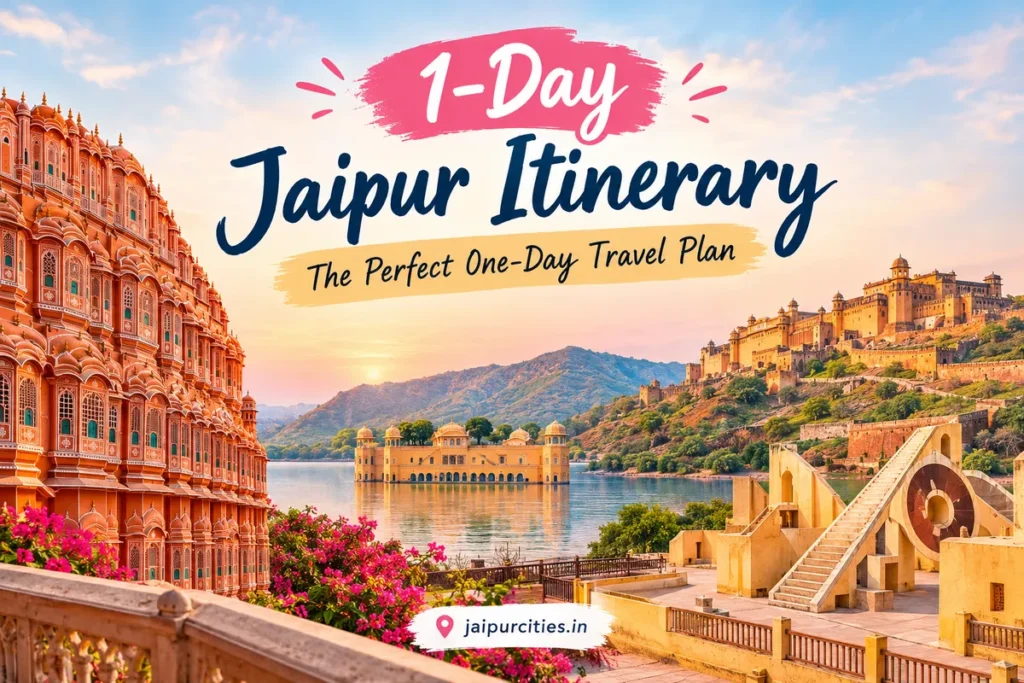
If you’ve only got a single day in the Pink City, the good news is that Jaipur is compact enough to reward you. The bad news is that it’s easy to lose hours in traffic, or linger so long at one monument that you miss the rest. A well-planned 1 day Jaipur itinerary fixes both.
Below is a realistic, hour-by-hour plan covering the biggest highlights: Amber Fort, Jal Mahal, Jantar Mantar, City Palace and Hawa Mahal, with a choice of endings for the evening. The idea is simple: start in the north, finish in the old city, and never double back.
This plan is part of our complete Jaipur Itinerary guide, which also covers two and three-day options.
Quick Overview: Jaipur in One Day
Best for: Travellers on a stopover, business visitors, day-trippers from Delhi or Agra, and anyone short on time.
Start time: 8:00 am (earlier in summer)
Transport: A hired cab or app-based taxi for the day is the easiest option.
Walking: Moderate, with some uphill stretches at Amber Fort.
Budget tip: Entry tickets are inexpensive for Indian visitors. Foreign visitors pay higher rates, so check current prices before you go.
The Route at a Glance
| Time | Place | Time Needed |
| 8:00 am | Amber Fort | 2 to 2.5 hours |
| 10:45 am | Jal Mahal (photo stop) | 15 to 20 minutes |
| 11:15 am | Lunch | 1 hour |
| 12:30 pm | Jantar Mantar | 45 minutes |
| 1:30 pm | City Palace | 1.5 hours |
| 3:15 pm | Hawa Mahal | 30 to 45 minutes |
| 4:30 pm | Bazaars or Nahargarh Fort sunset | 1.5 to 2 hours |
| 7:00 pm | Dinner | 1 to 1.5 hours |
Morning: Amber Fort (8:00 am)
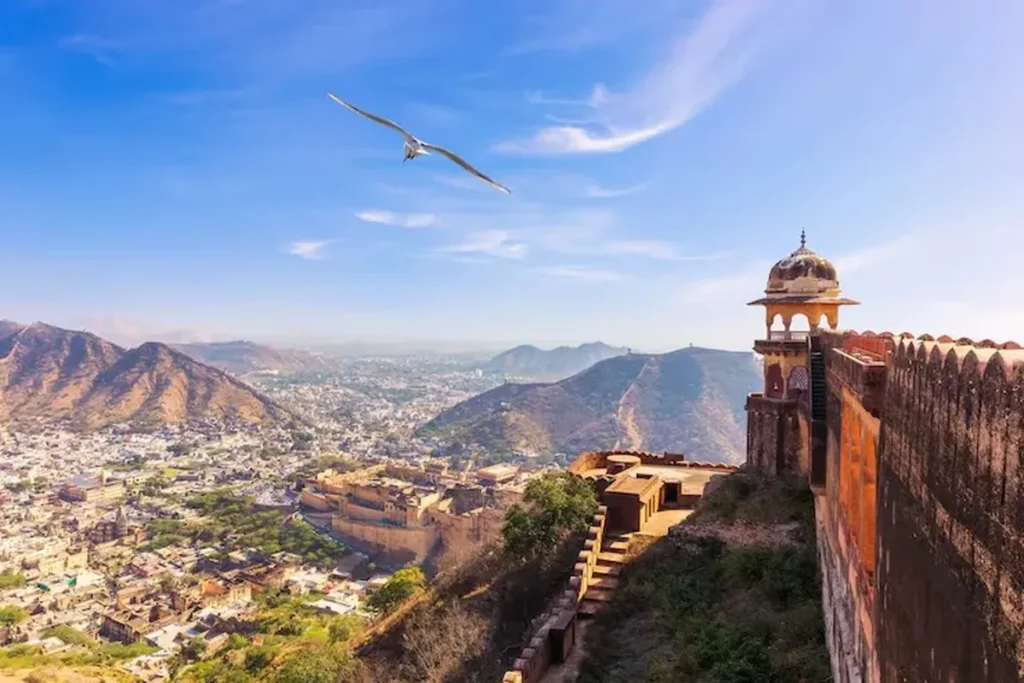
Start at Amber Fort, about 11 km from the city centre. Getting there right when it opens is the best decision you’ll make all day. Tour groups arrive fast, and the courtyards feel like a different place when they’re quiet.
Raja Man Singh I built the fort in 1592, and it blends Rajput and Mughal architecture in red sandstone and white marble. You enter through the grand Suraj Pol and climb to the main courtyard, where you’ll find the beautifully painted Ganesh Pol and the Diwan-i-Aam, the hall of public audience.
The showstopper is Sheesh Mahal, the Mirror Palace, where thousands of tiny mirrors cover the walls and ceiling. Legend says a single candle was enough to light the whole room like a night sky. Don’t skip Sukh Niwas, where channels once carried cool water to air-condition the room naturally, or the terraces overlooking Maota Lake.
Getting up the hill: You can walk the ramp, take a jeep from the base, or ride an elephant if the service is running, though many travellers now skip that for animal-welfare reasons. In the cooler hours, walking is easy and gives you better views.
Tip: If you have a little time to spare, stop at Panna Meena ka Kund, a geometric stepwell close to the fort. It’s a small stop, but very photogenic. Jaigarh Fort sits on the ridge above Amber and is well worth seeing, but on a one-day plan it’s better saved for a longer trip.
Mid-Morning: Jal Mahal Photo Stop (10:45 am)
On the road back to the city, you’ll pass Jal Mahal, the sandstone palace that seems to float in the middle of Man Sagar Lake. You can’t go inside, as it’s closed to the public, but the view from the lakeside promenade is worth a quick stop.
Give it 15 to 20 minutes. Take your photos, grab a cup of chai or a handicraft from the stalls, and move on. Mornings are best, when the lake is calm and the sun lights up the palace’s pale façade.
Lunch Break (11:15 am)
By now you’ll be hungry, so slow down and try some Jaipur classics:
- Dal baati churma: Baked wheat balls with lentils and sweet crumbled wheat. This is Rajasthan’s signature meal.
- Pyaaz kachori: A crisp, spiced onion-stuffed snack, perfect if you want something lighter.
- Laal maas: A fiery red mutton curry for meat lovers.
- Lassi: A thick, creamy yoghurt drink served in a clay cup, ideal in the afternoon heat.
You’ll find good options around MI Road, the Old City and near Hawa Mahal. Pick a place close to Jantar Mantar, your next stop, to save time.
Afternoon: Jantar Mantar and City Palace (12:30 pm)
Jantar Mantar
Jantar Mantar is a short walk from City Palace, so it makes sense to see them back to back. Maharaja Sawai Jai Singh II built this astronomical observatory in 1734, and it’s filled with giant stone and marble instruments. UNESCO added it to the World Heritage list in 2010.
The star is the Samrat Yantra, the world’s largest stone sundial. It stands about 27 metres tall and can tell the time to within a couple of seconds. The other instruments track the sun, moon and stars. A guide or audio guide makes a big difference here, because without one the instruments look like abstract sculptures.
Plan on around 45 minutes. It’s open air, so bring a hat in summer.
City Palace
Walk over to City Palace, the royal residence built between 1729 and 1732, which the former royal family still partly occupies. It mixes Rajasthani, Mughal and European styles across several courtyards, gardens and buildings.
Highlights include:
- Mubarak Mahal, which houses a textile and costume museum.
- Pritam Niwas Chowk, with four small gateways decorated with peacocks, lotus flowers and other motifs representing the seasons.
- Chandra Mahal, the seven-storey palace whose flag tells you whether the royal family is in residence.
- The Armoury, with ceremonial weapons, and two enormous silver urns once used to carry Ganga water to England.
Set aside about 90 minutes. If you’re short on time, stick to the main courtyard, the museum and the gateways.
Late Afternoon: Hawa Mahal (3:15 pm)
Just minutes from City Palace stands the most famous face of Jaipur. Maharaja Sawai Pratap Singh built Hawa Mahal in 1799, and architect Lal Chand Ustad designed it. The “Palace of Winds” has 953 small windows, called jharokhas, which let the royal women watch street life without being seen.
There are two ways to enjoy it. You can look at the façade from the road, or from one of the rooftop cafés across the street, which is the classic spot for the perfect photo. Or you can go inside and climb the narrow passages to the upper levels. The interior is simple, but the views of Jantar Mantar and City Palace are great.
Allow 30 to 45 minutes, plus a coffee on a terrace if you can.
Evening: Choose Your Ending (4:30 pm)
After a day of monuments, pick the finish that suits your mood.
Option 1: Bazaars of the Old City. The markets around Hawa Mahal are some of the liveliest in India. Johari Bazaar is known for jewellery and textiles, Bapu Bazaar for juttis, bags and block-print fabrics, and Tripolia Bazaar for lac bangles and brassware. Wander slowly, try a few street snacks and bargain politely. For a sure-fire souvenir, look for block-printed cotton, blue pottery or leather juttis.
Option 2: Sunset at Nahargarh Fort. If you’d rather have a view, head to Nahargarh Fort on the Aravalli ridge above the city. Built in 1734, it has a wide terrace with all of Jaipur spread out below. Sunset here is something special, and the fort’s café is a lovely place to sit while the lights come on. Arrive early enough to explore the walls and corridors before the golden hour.
Option 3: Albert Hall Museum After Dark. Albert Hall Museum is Jaipur’s oldest, designed in the Indo-Saracenic style. Even if you don’t go in, the building looks beautiful lit up at night and makes a great photo. If it’s open when you arrive, the collection of paintings, carpets, ivory work and sculptures is worth a look.
Dinner (7:00 pm)
End the day with a relaxed Rajasthani dinner. Many restaurants serve thali meals with a spread of local dishes, and some heritage properties add live folk music. If you’ve got a sweet tooth, finish with ghewar or a plate of fresh jalebi.
Practical Tips for Your One-Day Trip
- Book a cab for the day. A full-day hire with a driver is usually the most efficient way to follow this route without wasting time hunting for transport.
- Buy tickets online where you can. Some monuments offer online booking, which saves time in queues. A composite ticket for multiple monuments is sometimes available, so ask at the first gate.
- Wear comfortable shoes. Amber Fort and Nahargarh both involve plenty of stone steps and ramps.
- Carry water, sunscreen and a light scarf. The sun can be strong, especially from March to October.
- Check closing days. Most monuments are open daily, but museums may close on certain days. Confirm timings before you set off.
- Stay flexible. If one place is taking longer than planned, skip a stop rather than rushing through everything. Jantar Mantar and Hawa Mahal are the easiest to shorten.
If You Have More Time
If you find yourself falling for the city halfway through the day, stretch this plan into our 2-Day Jaipur Itinerary, which adds Jaigarh Fort and Nahargarh at a more relaxed pace. And if you’d like temples, craft villages and a deeper taste of local life, our 3-Day Jaipur Itinerary covers all of it.
One Day, One Unforgettable Pink City
Even a short visit leaves a strong impression on you in Jaipur. With a good route and an early start, one day can take you from a hilltop fort to a royal palace, an ancient observatory and a buzzing bazaar. Follow this plan, stay flexible, and you’ll head home with great photos, a full stomach and a reason to come back.
Want to stay longer? Head back to our main Jaipur Itinerary guide and pick the plan that suits you best.
Frequently Asked Questions
Is one day enough to see Jaipur?
It’s enough for the main highlights: Amber Fort, City Palace, Jantar Mantar and Hawa Mahal. You won’t see everything, but you’ll get a clear feel for the city.
What is the best order to visit places in Jaipur in one day?
Start with Amber Fort in the morning, stop at Jal Mahal on the way back, and spend the afternoon in the old city at Jantar Mantar, City Palace and Hawa Mahal. That way you never backtrack.
What time should I start?
Around 8:00 am is ideal. In summer, go even earlier.
Can I do Jaipur in one day from Delhi?
Yes, though it makes for a long day. The drive takes about five to six hours each way, so many travellers take an early train and return in the evening.